Posts Tagged ‘Holocaust’

Please, Keep This Going

Monday, March 14th, 2011

@@@@@@@@@@@@

Yom HaShoah – Holocaust Remembrance Day

Please wait 20 Seconds before you close this e-mail.

This message asks you to do one small act to remember the six million (6,000,000) Jewish lives that were lost during the Holocaust.

Please send this message to everyone you know who is Jewish,
and ask them to also forward this to others.

If we reach the goal of reaching six million e-mail names before April 20th, we will fulfill and give back to God what He gave to us:
6 million Jews who are alive today who remember those who perished.

Thank you

DiggStumbleUponRedditDeliciousBeboMySpaceOrkutRead It LaterTumblrShare

Memories

Monday, August 30th, 2010

http://www.youtube.com/watch?v=Gdk0qcsUvNU&feature=player_embedded

DiggStumbleUponRedditDeliciousBeboMySpaceOrkutRead It LaterTumblrShare

My Number Was 70819

Friday, August 27th, 2010
DiggStumbleUponRedditDeliciousBeboMySpaceOrkutRead It LaterTumblrShare

Let’s not Forget

Thursday, July 1st, 2010

When I was a kid, I couldn’t understand why Eisenhower was so popular. Maybe this will explain why.

camp01

General Eisenhower warned us..

camp02

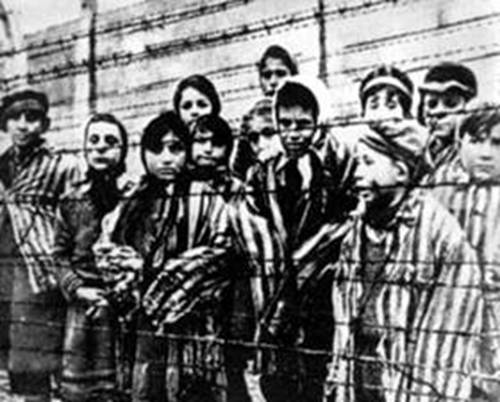
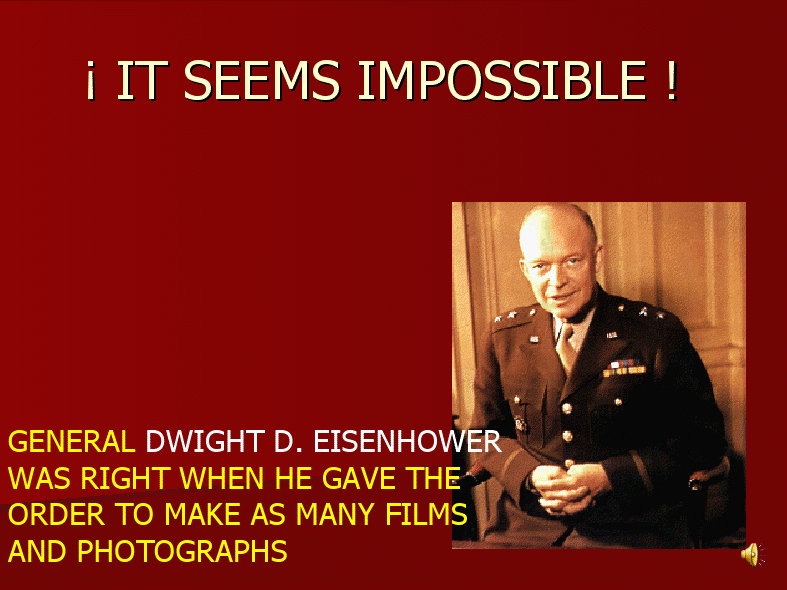
It is a matter of history that when the Supreme Commander of the Allied Forces, General Dwight Eisenhower, found the victims of the death camps he ordered all possible photographs to be taken, and for the German people from surrounding villages to be ushered through the camps and even made to bury the dead.
He did this because he said in words to this effect:
‘Get it all on record now – get the films – get the witnesses -because somewhere down the road of history some bastard will get up and say that this never happened’.
This week, the UK debated whether to remove The Holocaust from its school curriculum because it ‘offends’ the Muslim population which claims it never occurred. It is not removed as yet.. However, this is a frightening portent of the fear that is gripping the world and how easily each country is giving into it.
It is now more than 60 years after the Second World War in Europe ended. This e-mail is being sent as a memorial chain, in memory of the 6 million Jews, 20 million Russians, 10 million Christians, and 1,900 Catholic priests Who were ‘murdered, raped, burned, starved, beaten, experimented on and humiliated’ while the German people looked the other way!
Now, more than ever, with Iran, among others, claiming the Holocaust to be ‘a myth,’ it is imperative to make sure the world never forgets.

camp03

This e-mail is intended to reach 400 million people! Be a link in the memorial chain and help distribute this around the world.
How many years will it be before the attack on the World Trade Center

‘NEVER HAPPENED’,

9-11jpg

Because it offends some Muslim in the U.S. ???
Do not just delete this message; it will take only a minute to pass this along.

FREEDOM ISN’T FREE… SOMEONE HAD TO PAY FOR IT

DiggStumbleUponRedditDeliciousBeboMySpaceOrkutRead It LaterTumblrShare

In Memory…

Thursday, March 4th, 2010

candle

Holocaust Remembrance Day – May 2

Please wait 20 Seconds before you close this e-mail.

This message asks you to do one small act to remember the six million (6,000,000) Jewish lives that were lost during the Holocaust.

Send this message to everyone you know who is Jewish.

If we reach the goal of reaching six million e-mail names before May 2, we will fulfill and give back to G-d what He gave to us:

6 million Jews who are alive today who remember those who perished.

Please send this message and Ask them to also forward it to others.

Thank you.

DiggStumbleUponRedditDeliciousBeboMySpaceOrkutRead It LaterTumblrShare

The Wedding Gown That Made History

Saturday, July 4th, 2009

Lilly Friedman doesn’t remember the last name of the woman who designed and sewed the wedding gown she wore when she walked down the aisle over 60 years ago. But the grandmother of seven does recall that when she first told her fiancé Ludwig that she had always dreamed of being married in a white gown he realized he had his work cut out for him.

For the tall, lanky 21-year-old who had survived hunger, disease and torture this was a different kind of challenge. How was he ever going to find such a dress in the Bergen Belsen Displaced Person’s camp
where they felt grateful for the clothes on their backs?

Fate would intervene in the guise of a former German pilot who walked into the food distribution center where Ludwig worked, eager to make a trade for his worthless parachute. In exchange for two pounds of coffee beans and a couple of packs of cigarettes Lilly would have her wedding gown.

For two weeks Miriam the seamstress worked under the curious eyes of her fellow DPs, carefully fashioning the six parachute panels into a simple, long sleeved gown with a rolled collar and a fitted waist that tied in the back with a bow. When the dress was completed she sewed the leftover material into a matching shirt for the groom.

A white wedding gown may have seemed like a frivolous request in the surreal environment of the camps, but for Lilly the dress symbolized the innocent, normal life she and her family had once led before the world descended into madness. Lilly and her siblings were raised in a Torah observant home in the small town of Zarica, Czechoslovakia where her father was a melamed, respected and well liked by the young yeshiva students he taught in nearby Irsheva.

He and his two sons were marked for extermination immediately upon arriving at Auschwitz . For Lilly and her sisters it was only their first stop on their long journey of persecution, which included Plashof, Neustadt, Gross Rosen and finally Bergen Belsen .

weddingown

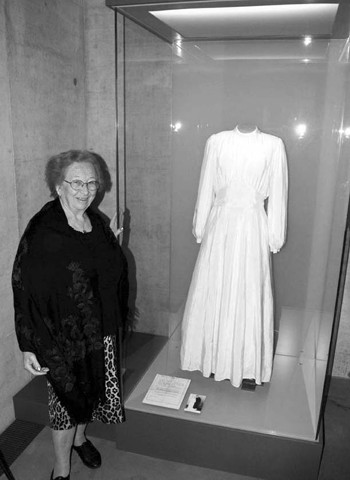
Lilly Friedman and her parachute dress on display in the Bergen Belsen Museum

Four hundred people marched 15 miles in the snow to the town of Celle on January 27, 1946 to attend Lilly and Ludwig’s wedding. The town synagogue, damaged and desecrated, had been lovingly renovated by the DPs with the meager materials available to them. When a Sefer Torah arrived from England they converted an old kitchen cabinet into a makeshift Aron Kodesh.

“My sisters and I lost everything – our parents, our two brothers, our homes. The most important thing was to build a new home.” Six months later, Lilly’s sister Ilona wore the dress when she married Max Traeger. After that came Cousin Rosie. How many brides wore Lilly’s dress? “I stopped counting after 17.” With the camps experiencing the highest marriage rate in the world, Lilly’s gown was in great demand.

In 1948 when President Harry Truman finally permitted the 100,000 Jews who had been languishing in DP camps since the end of the war to emigrate, the gown accompanied Lilly across the ocean to America . Unable to part with her dress, it lay at the bottom of her bedroom closet for the next 50 years, “not even good enough for a garage sale. I was happy when it found such a good home.”

Home was the U.S. Holocaust Memorial Museum in Washington , D.C. When Lily’s niece, a volunteer, told museum officials about her aunt’s dress, they immediately recognized its historical significance and displayed the gown in a specially designed showcase, guaranteed to preserve it for 500 years.

But Lilly Friedman’s dress had one more journey to make. Bergen Belsen , the museum, opened its doors on October 28, 2007. The German government invited Lilly and her sisters to be their guests for the grand opening. They initially declined, but finally traveled to Hanover the following year with their children, their grandchildren and extended families to view the extraordinary exhibit created for the wedding dress made from a parachute.

Lilly’s family, who were all familiar with the stories about the wedding in Celle , were eager to visit the synagogue. They found the building had been completely renovated and modernized. But when they pulled aside the handsome curtain they were astounded to find that the Aron Kodesh, made from a kitchen cabinet, had remained untouched as a testament to the profound faith of the survivors. As Lilly stood on the bimah once again she beckoned to her granddaughter, Jackie, to stand beside her where she was once a kallah. “It was an emotional trip. We cried a lot.”

Two weeks later, the woman who had once stood trembling before the selective eyes of the infamous Dr. Josef Mengele returned home and witnessed the marriage of her granddaughter.

The three Lax sisters – Lilly, Ilona and Eva, who together survived Auschwitz, a forced labor camp, a death march and Bergen Belsen – have remained close and today live within walking distance of each other in Brooklyn. As mere teenagers, they managed to outwit and outlive a monstrous killing machine, then went on to marry, have children, grandchildren and great-grandchildren and were ultimately honored by the country that had earmarked them for extinction.

As young brides, they had stood underneath the chuppah and recited the blessings that their ancestors had been saying for thousands of years. In doing so, they chose to honor the legacy of those who had perished by choosing life.

~~~~~~~~~~~~~~~~~~~~~~~~~~~~~~~~~~~~~~~~~

In MEMORIAM – 63 YEARS LATER

It is now more than 60 years after the Second World War in Europe ended. This e-mail is being sent as a memorial chain, in memory of the six million Jews, 20 million Russians, 10 million Christians and 1,900 Catholic priests who were murdered, massacred, raped, burned, starved and humiliated with the German and Russian peoples looking the other way!

Now, more than ever, with Iraq, Iran, and others, claiming the Holocaust to be ‘a myth,’ it’s imperative to make sure the world never forgets, because there are others who would like to do it again.

DiggStumbleUponRedditDeliciousBeboMySpaceOrkutRead It LaterTumblrShare

It Seems Impossible

Saturday, June 6th, 2009

impossible01

impossible02

impossible031

impossible04

impossible05

impossible06

impossible07

impossible08

impossible09

impossible10

impossible11

DiggStumbleUponRedditDeliciousBeboMySpaceOrkutRead It LaterTumblrShare

Beautiful Story

Sunday, May 31st, 2009

YOU MUST READ AND SEND IT TO FRIENDS AND FAMILY

WOW!!! A true story — read it to the end.

Girl with an Apple

August 1942. Piotrkow, Poland. The sky was gloomy that morning
as waited anxiously. All the men, women and children of Piotrkow’s
Jewish ghetto had been herded into a square. Word had gotten around that we were being moved.

My father had only recently died from typhus, which had run rampant through the crowded ghetto. My greatest fear was that
our family would be separated.

‘Whatever you do,’ Isidore, my eldest brother, whispered to me, ‘don’t tell them your age.. Say you’re sixteen.’
I was tall for a boy of 11, so I could pull it off. That way I might be deemed valuable as a worker. An SS man approached me, boots clicking against the cobblestones. He looked me up and down, then asked my age. ‘Sixteen,’ I said. He directed me to the left, where my three brothers and other healthy young men already stood.

My mother was motioned to the right with the other women,
children, sick and elderly people. I whispered to Isidore, ‘Why?’ He didn’t answer. I ran to Mama’s side and said I wanted to stay with her. ‘No,’ she said sternly. ‘Get away. Don’t be a nuisance. Go with your brothers.’ She had never spoken so harshly before. But I understood: She was protecting me. She loved me so much that, just this once, she pretended not to. It was the last I ever saw of her.

My brothers and I were transported in a cattle car to Germany. We
arrived at the Buchenwald concentration camp one night weeks
later and were led into a crowded barrack. The next day, we were issued uniforms and identification numbers. ‘Don’t call me Herman anymore.’ I said to my brothers. ‘Call me 94983.’

I was put to work in the camp’s crematorium, loading the dead into
a hand-cranked elevator. I, too, felt dead. Hardened, I had
become a number. Soon, my brothers and I were sent to Schlieben, one of Buchenwald’s sub-camps near Berlin .

One morning I thought I heard my mother’s voice, ‘Son,’ she said
softly but clearly, I am going to send you an angel.’ Then I woke
up. Just a dream. A beautiful dream. But in this place there could be no angels. There was only work. And hunger. And fear..

A couple of days later, I was walking around the camp, around the
barracks, near the barbed-wire fence where the guards could not
easily see. I was alone. On the other side of the fence, I spotted someone: a little girl with light, almost luminous curls. She was half- hidden behind a birch tree. I glanced around to make sure no one saw me. I called to her softly in German. ‘Do you have something to eat?’ She didn’t understand. I inched closer to the fence and repeated question in Polish. She stepped forward. I was thin and gaunt, with rags wrapped around my feet, but the girl looked unafraid. In her eyes, I saw life. She pulled an apple from her woolen jacket and threw it over the fence. I grabbed the fruit and, as I started to run away, I heard her say faintly, ‘I’ll see you tomorrow.’

I returned to the same spot by the fence at the same time every
day. She was always there with something for me to eat – a hunk of bread or, better yet, an apple. We didn’t dare speak or linger. To be caught would mean death for us both. I didn’t know anything about her, just that she was a kind farm girl, and that she understood Polish. What was her name? Why was she risking her life for me?
Hope was in such short supply, and this girl on the other side of the fence gave me some, as nourishing in its way as the bread and apples.

Nearly seven months later, my brothers and I were crammed into a
coal car and shipped to Theresienstadt camp in Czechoslovakia.
‘Don’t return,’ I told the girl that day. ‘We’re leaving.’ I turned toward the barracks and didn’t look back, didn’t even say good-bye to the little girl whose name I’d never learned, the girl with the apples.

We were in Theresienstadt for three months. The war was winding
down and Allied forces were closing in, yet my fate seemed sealed. On May 10, 1945, I was scheduled to die in the gas chamber at 10:00 AM. In the quiet of dawn, I tried to prepare myself. So many times death seemed ready to claim me, but somehow I’d survived.. Now, it was over. I thought of my parents. At least, I thought, we will be reunited.

But at 8 A.M there was a commotion. I heard shouts, and saw
people running every which way through camp. I caught up with my brothers. Russian troops had liberated the camp! The gates swung open. Everyone was running, so I did too.

Amazingly, all of my brothers had survived; I’m not sure how. But I
knew that the girl with the apples had been the key to my survival.
In a place where evil seemed triumphant, one person’s goodness had saved my life, had given me hope in a place where there was none. My mother had promised to send me an angel, and the angel had come.

Eventually I made my way to England where I was sponsored by
a Jewish charity, put up in a hostel with other boys who had survived the Holocaust and trained in electronics. Then I came to America , where my brother Sam had already moved. I served in the U. S. Army during the Korean War, and returned to New York City after two years. By August 1957 I’d opened my own electronics repair shop. I was starting to settle in.

One day, my friend Sid who I knew from England called me.
‘I’ve got a date. She’s got a Polish friend. Let’s double date.’
A blind date? Nah, that wasn’t for me. But Sid kept pestering me, and a few days later we headed up to the Bronx to pick up his date and her friend Roma. I had to admit, for a blind date this wasn’t so bad.
Roma was a nurse at a Bronx hospital. She was kind and smart. Beautiful, too, with swirling brown curls and green, almond-shaped eyes that sparkled with life.

The four of us drove out to Coney Island . Roma was easy to talk
to, easy to be with. Turned out she was wary of blind dates too!
We were both just doing our friends a favor. We took a stroll on the boardwalk, enjoying the salty Atlantic breeze, and then had
dinner by the shore. I couldn’t remember having a better time.

We piled back into Sid’s car, Roma and I sharing the backseat. As
European Jews who had survived the war, we were aware that much had been left unsaid between us. She broached the subject,
‘Where were you,’ she asked softly, ‘during the war?’
‘The camps,’ I said, the terrible memories still vivid, the irreparable loss. I had tried to forget. But you can never forget.
She nodded. ‘My family was hiding on a farm in Germany , not far
from Berlin,’ she told me. ‘My father knew a priest, and he got us Aryan papers.’ I imagined how she must have suffered too, fear,
a constant companion. And yet here we were, both survivors, in a new world.

‘There was a camp next to the farm.’ Roma continued. ‘I saw a boy
there and I would throw him apples every day.’
What an amazing coincidence that she had helped some other boy.
‘What did he look like? I asked He was tall, skinny, and hungry. I must have seen him every day for six months.’
My heart was racing. I couldn’t believe it. This couldn’t be. ‘Did
he tell you one day not to come back because he was leaving
Schlieben?’
Roma looked at me in amazement. ‘Yes,’
That was me! ‘I was ready to burst with joy and awe, flooded with emotions. I couldn’t believe it! My angel.
‘I’m not letting you go.’ I said to Roma. And in the back of the
car on that blind date, I proposed to her. I didn’t want to wait.
‘You’re crazy!’ she said. But she invited me to meet her parents
for Shabbat dinner the following week. There was so much I looked
forward to learning about Roma, but the most important things I always knew: her steadfastness, her goodness. For many months, in the worst of circumstances, she had come to the fence and given me hope. Now that I’d found her again, I could never let her go.

That day, she said yes. And I kept my word. After nearly 50 years
of marriage, two children and three grandchildren I have never let
her go.

Herman Rosenblat, Miami Beach , Florida

This is a true story and you can find out more by Googling Herman
Rosenblat as he was Bar Mitzvahed at age 75. This story is being
made into a movie called “The Fence”.

Join us and be a link in the memorial chain and help us distribute
it around the world.

Please tell about this e-mail to people you know and ask them to
continue the memorial chain.

DiggStumbleUponRedditDeliciousBeboMySpaceOrkutRead It LaterTumblrShare

From a Friend

Tuesday, April 14th, 2009

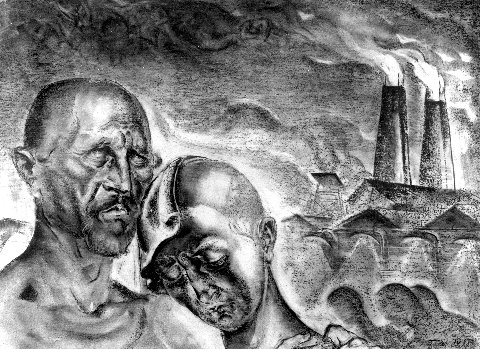
It is my privilege to introduce you to some of the work of Master Ludovit Feld from our collection, whom I had the opportunity to know during his lifetime in Kosice, Kassa Slovakia. It is only appropriate to share such a powerful testimony captured by this giant of an artist, so small in height.

Picture #1 Father and Son – Mengele experiment in Auschwitz with background of gas chambers
1948 Original black charcoal drawing 25″x 18″ / 64 x 46 cm /

feld1

Picture #2 Mass Funeral in Teglagyar Kassa, Ghetto in the brick factory in Kosice Slovakia
1944 Original black charcoal drawing 25″x18 ” / 64 x 46 cm /

feld2

Picture #3 In Memoriam Auschwitz, Artist’s vision of women in the gas chamber gasping for their last breath
1959 Original charcoal drawing 22″x15″ / 56 x 38 cm

feld3

DiggStumbleUponRedditDeliciousBeboMySpaceOrkutRead It LaterTumblrShare

In Memoriam 63 Years Later

Sunday, March 29th, 2009

Please read the little cartoon carefully, it’s powerful. Then read the comments at the end.
I’m doing my small part by forwarding this message. I hope you’ll consider doing the same.

inmemoriam

inmemory011

It is now more than 60 years after the Second World War in Europe ended. This e-mail is being sent as a memorial chain, in memory of the six million Jews, 20 million Russians, 10 million Christians and 1,900 Catholic priests who were murdered, massacred, raped, burned, starved and humiliated with the German and Russian Peoples looking the other way!

Now, more than ever, with Iraq, Iran, and others, claiming the Holocaust to be ‘a myth,’ it’s imperative to make sure the world never forgets, because there are others who would like to do it again.

This e-mail is intended to reach 40 million people worldwide!

Join us and be a link in the memorial chain and help us distribute it around the world. israeliflag

DiggStumbleUponRedditDeliciousBeboMySpaceOrkutRead It LaterTumblrShare